
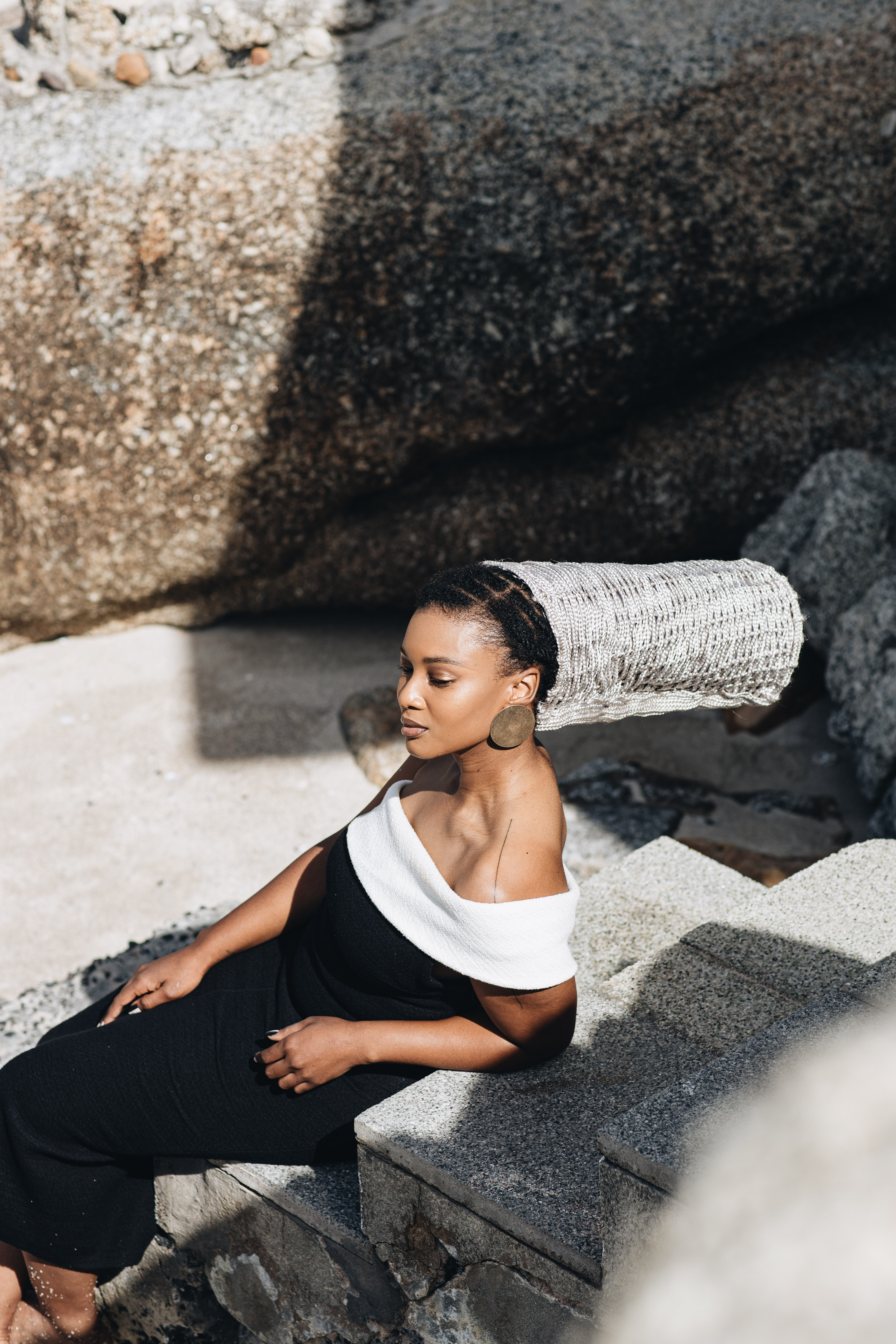
Blackrose creates from a universe all her own, where music, design, and art intersect seamlessly. By drawing from her experiences and identity, she has developed a consistent style and voice that reflects who she is a proud Zulu woman from KwaZulu, and the stories she tells through her work.
We had the honour of having her as one of our special women’s month Five @ Five series and this is what she had to say.
1. Your bio says “Black is the Canvas.” What does that mean for you personally, and how does it show up in your work?
My artistic pseudonym is “BlackRose”. It references the beauty of the flower, but more importantly, it is a sentence. Black, Rose – the rise of black people. “Black Is The Canvas” is then the slogan behind my name. It is a reminder that who I am, what I am, is the blueprint. It is a call to return to self at all times, in all ways. This theme ripples through the work I do. I create to uplift the African spirit, to remind it where it comes from so it may know where it is going.
2. Hair is often seen as both personal and political in African cultures. How do you approach designing hair as an art form, and what stories are you hoping to tell through it?
My approach to hair design is personal first and political immediately after. I pull from my own bloodline in the works I create, which informs what I make and how I make it. The initial idea was to uplift the women who made me by celebrating how they wore their hair. I want to keep them alive in a world that works tirelessly, to bury them and tell their stories through observers who do not carry them in their souls. I carry them, and so I can tell their story in an uplifting & celebratory manner. I hope that will create more conversations on the importance of celebrating our roots and loving the way we look first, the rest is secondary.
3. Since you do a mix of things, from hair art to other creative work, how do you keep your style and voice consistent across it all?
There is an entire universe in my head; everything I make comes from that place. I believe in referencing myself, and that is how I keep my style and voice consistent. It has taken me ten years, but I have found a way to make all my art forms complementary. The music I make has the same feel as the headpieces I create; they work together because the source is the same. The message is the same—it is who I am: a proud Zulu woman from KwaZulu.

4. You’ve been part of Hair To The Throne and collaborated with brands like Nike. How has working on bigger platforms shaped your perspective as an artist?
I was honoured to participate in Hair to the Throne, and it opened my mind to what I could do. My exploration with Hair Art was very personal at first; I was creating an image for myself as an artist. The show helped me realise that what I was doing for myself could very well become something bigger for other African people walking the path to find themselves. My world opened up even more when I collaborated with Nike; it shifted the way I saw my work and stretched me to imagine more in terms of my art. I never thought you could combine hair and an athletic company, but it showed me just how creative I can be in bringing my work and message into different spaces. There are no limits, and someone is always watching your work and admiring it.
5. What impact do you hope your work has when people see it, especially in how African identity and beauty are represented?
I like to think of my work as an archive, a modern archive, but an archive nonetheless. My aim is to interrogate our relationship with natural hair and the choices we make in beautifying it. I want the conversation to shift from frustration over our curls to a celebration of our curl patterns; from exasperation at the time it takes to care for our hair, to a sense of love and ease in that very process. Africans devoted so much care to their hair because we understood it as a spiritual antenna—nurturing it was nurturing the spirit itself. That act is a step toward reclaiming selfhood and our stolen power. For us, black should always remain the canvas.

Photography: Ntikana Ramohlale
 Culture Club - Magazine