

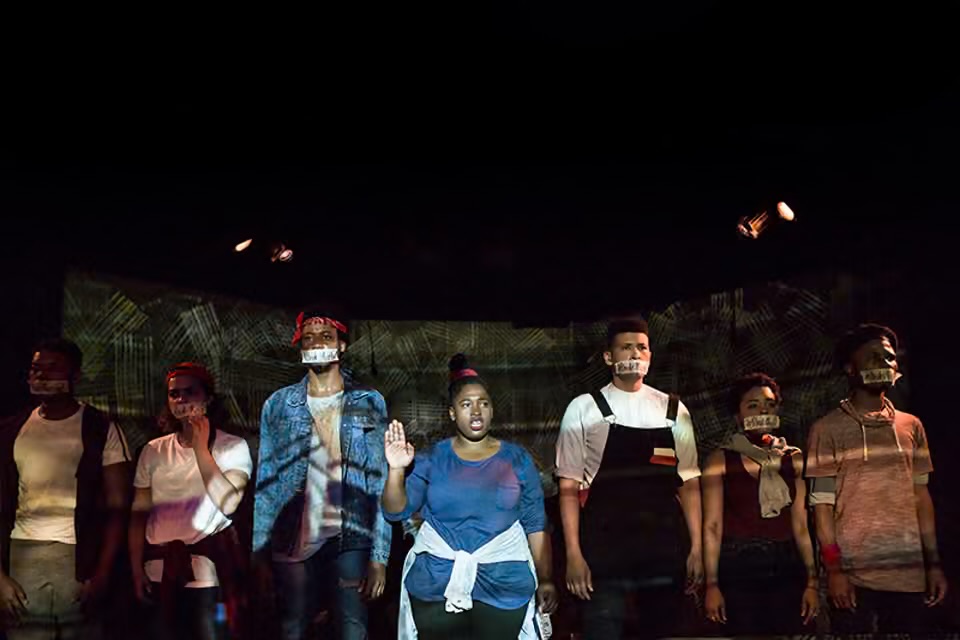
The lights go down, and a chorus of voices fills the auditorium. The cast of The Fall invites us into the world of protest song and amagwijo, an entrance into the world of conflict, disagreement, learning and unlearning, politics, and ideological differences of the student body in 2015 UCT. We bear witness to a myriad of stories and perspectives in the days leading up to and following the removal of the statue of Cecil John Rhodes at UCT.
The production, The Fall, is also the only mainstream stage work to document the 2015 #RhodesMustFall movement and subsequent student protest movements at the University of Cape Town. Directed by 2022 Standard Bank Young Artist award winners, TheatreDuo & Co, the production unravels complex conversations around gender, race, sex, class and other intersectionalities. It also speaks on decolonisation, colonisation, patriarchy, misogyny, and other institutionalized systems.
It is a beautiful, well-made play. But, perhaps, too beautiful, too clean, too composed? In a Q&A session following the piece, these are some of the concerns that arise. The word complex becomes a suitable adjective for the evening. The Q&A called us, the audience, to ask questions of the cast, provide feedback, and share what resonated with us. For me, this, more than the play, is the moment that encapsulates the essence of the #RhodesMustFall, #FeesMustFall, and even the #RUReferencelist movement.

Student leaders who were part of the movement, now audience to the events of their lives, feel betrayed by the work. It says little of hurt. One audience member says that it does not tell the stories on the ground at the time. Its form is polished, familiar, and put together. It does not speak much of state violence, of the extent of violent masculinities within the student leaders, or even of acts of sexual violence towards women students by their male counterparts. Instead, we enjoy clean, palatable, pleasant-enough storytelling that misses the depth, heaviness, and dragging impact of the movement on students then and now. The Fall is beautiful-enough theatre, but it is incomplete.
Another audience member makes a relevant offering, however. They suggest that it is not the role of the actors, producers, and other creatives to tell the whole story of #RhodesMustFall and subsequent protest movements like #FeesMustFall and #RUReferencelist. This is but one representation, and there is space for much more to be said and done. In fact, this must be the case. More work, different works, and contrasting perspectives must find a space on the stage and in other art forms.
Yet another contribution illustrates how little the general public knew about students’ experiences during the protests. They share their gratefulness for the accessibility that the production gives them, how it brings them closer to understanding the events of the movement.
Ten years since the protest, nine since I was a first-year myself, I leave the theatre carrying the load from the Q&A, the conversations of remembrance with my friends, and my memories of various days and nights of protest. I can see that much can be considered ‘missing’ from the production, but I can also note the fullness of intention with which it was made and the efforts of the team that created it. It is not a work that promises completion. Rather, like the effects, issues, and questions of the #RhodesMustFall, #FeesMustFall, and #RUReferencelist protests, it endures and makes attempts. And sometimes, that is a sufficient beginning.
 Culture Club - Magazine