
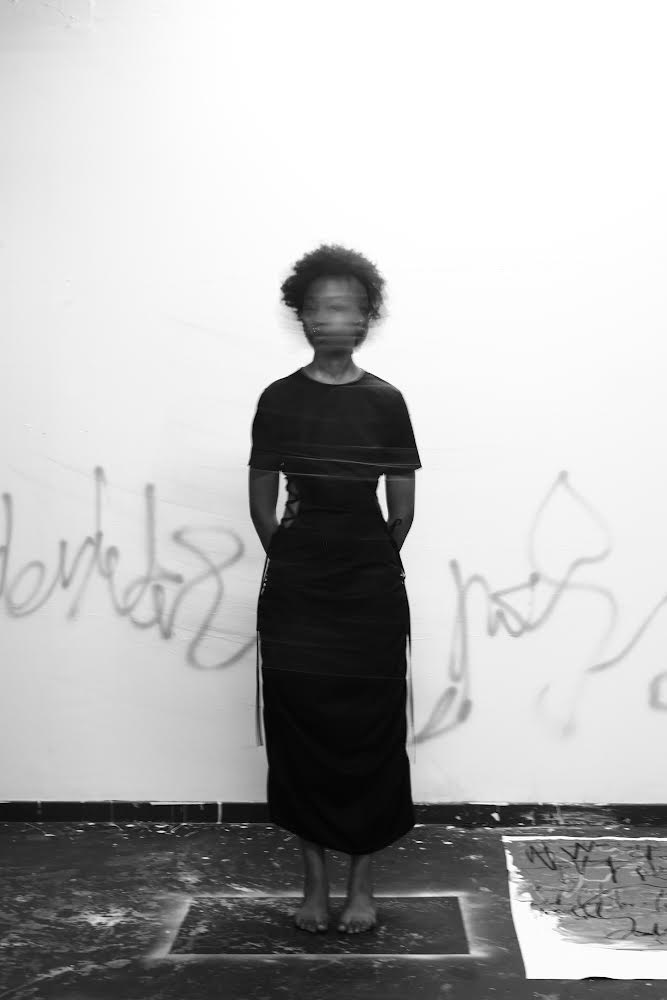
This artist’s work goes beyond language, influenced by growing up around different languages. She uses text and calligraphy to create a “language of feeling and flow,” expressing ideas without relying on words. Mankebe Seakgoe is a visual artist whose work often emphasises themes of language, history, and identity. As she gets ready to show her nature-inspired art at FNB Art Joburg, she hopes viewers will take their time, feel a bit uncomfortable, and find new ways to understand her work.
How has your experience with different languages during childhood influenced the way you incorporate text and calligraphy in your work?
When you spend a lot of time around people who speak a language that’s foreign to you, you start to experience communication beyond words. It made me realise that there’s a world of understanding that exists where words don’t matter. Because I think and understand things in different languages, that conflict becomes even more frustrating to me when I speak. So I started writing and over time the writing gave birth to a language of feeling and flow, which is more like a dance experienced through the body.
Your work often challenges conventional ways of communicating. What do you hope viewers take away from your exploration of legibility and understanding?
The work manifests as these windows to my worlds of wonder and at times I find myself lost in these worlds. I find it funny how often we almost need to be relieved from confusion, no one wants to remain in that discomfort for too long. But being alive is uncomfortable because everything is constantly changing, so we can never fully understand anything, even ourselves. Maybe I hope anyone that encounters the work slows down and questions it.

Can you share more about your creative process, which you describe as a “dictation of thought in the absence of control”? How does this manifest in your work?
I don’t know if I can answer this or how. The process is never ending and ever-changing. It starts with meditation and flows through and out the body in different forms. Sometimes it feels as though I’m physically absent during the making process.
In your recent exhibition, ‘I Hear You,’ you explored the interplay of water and sky. How do these elements inform your overall artistic narrative?
I spend a good chunk of my time out in nature. It allows me moments to silence my mind and to hear outside of my body. I like to think of my work as documentations or translations of conversations. These elements not embody the essence of flow but also exist as carriers of messages, histories and knowledge which extends through my work.
What excites you most about showcasing your work at the upcoming FNB Art Joburg fair, and how do you see your work engaging with the audience there?
This would be the first presentation from the studio for the year, I’ve mostly just been working and living alone with the work. It may feel more nerve racking for me to have my work be seen again but it’s equally exciting because I’ve come to appreciate that the work is experiential. It exists outside of me and it has a new life every time it’s encountered, even by the same person. I’ve been playing with different ways of making and FNB Art Joburg is a very important fair, not only for Johannesburg but on the continent so to be a voice or even a whisper there is a great privilege.

 Culture Club - Magazine